Businesses manage multiple operations every day, including finance, inventory, sales, purchasing, customer management, and employee records. When these activities are handled through disconnected systems or manual processes, companies often face delays, errors, duplicate data, and limited visibility across departments. This is one of the main reasons why organizations invest in ERP software.
So, what does an ERP system actually do for a business? An ERP system connects core business operations into a centralized platform that helps companies manage processes more efficiently, improve accuracy, and support better decision-making. Understanding an ERP system is important for businesses planning to improve operational performance, reduce administrative workload, and maintain consistent workflows across departments.
In this blog, we will explain what an ERP system actually does, how ERP software supports different business operations, the key ERP system functions and features, ERP system benefits for business, how ERP improves business efficiency, and why businesses need ERP software to manage growth and operational performance more effectively.
What Does ERP Software Do?
Many companies ask, “What does ERP software do?” ERP, which stands for Enterprise Resource Planning, is business management software designed to integrate various operational functions into one system.
ERP software helps organizations:
- Manage accounting and financial records
- Monitor inventory and warehouse operations
- Track purchasing and supplier activities
- Handle sales and customer orders
- Support HR and payroll management
- Improve reporting and data analysis
- Maintain operational consistency
Instead of using separate tools for each department, ERP software creates a centralized environment where information is shared in real time. For example, when a sales order is created, the ERP system can automatically update inventory, notify the finance department, and generate procurement requirements if stock levels are low. This reduces manual coordination between teams and improves workflow efficiency.
ERP System Functions and Features
Understanding ERP system functions and features helps businesses evaluate how ERP software supports daily operations. While features may vary depending on the ERP provider, most systems include the following core modules.
1. Financial Management
Financial management is one of the most important ERP functions. Businesses can manage:
- General ledger
- Accounts payable
- Accounts receivable
- Bank reconciliation
- Tax management
- Financial reporting
ERP systems help finance teams maintain accurate records and generate reports faster for better decision-making.
2. Inventory and Warehouse Management
Inventory management allows businesses to track stock movement, product availability, and warehouse operations in real time.
Key functions include:
- Stock tracking
- Batch and serial number management
- Warehouse transfers
- Inventory valuation
- Reorder rules
- Demand forecasting
Accurate inventory data helps companies avoid stock shortages and overstocking issues.
3. Sales and Customer Management
ERP systems support sales operations by managing quotations, orders, invoicing, and customer records.
Features often include:
- Sales order management
- Customer database
- Quotation generation
- Pricing management
- Sales reporting
- Customer communication tracking
These tools help businesses maintain organized sales processes and improve customer service.
4. Purchasing and Supplier Management
ERP software also supports procurement activities through:
- Purchase order management
- Supplier records
- Vendor quotations
- Approval workflows
- Procurement reporting
Businesses can monitor supplier performance and control purchasing costs more effectively.
5. Human Resource Management
Many ERP systems include HR functionality for managing employee information and administrative tasks.
Common HR features include:
- Employee records
- Attendance tracking
- Payroll management
- Leave management
- Recruitment support
- Performance evaluation
Centralized HR management reduces administrative complexity and improves record accuracy.
6. Reporting and Analytics
ERP reporting tools provide businesses with real-time access to operational data. Companies can generate reports related to:
- Revenue
- Expenses
- Sales performance
- Inventory movement
- Employee productivity
- Procurement activities
These insights help management teams make informed decisions based on accurate business data.
What Does an ERP System Actually Do for Long-Term Growth?
An ERP system supports long-term business growth by centralizing core operations such as finance, inventory, sales, procurement, human resources, and customer management into one unified platform. As businesses expand, managing multiple departments through disconnected systems often creates reporting delays, operational inefficiencies, and data inaccuracies.
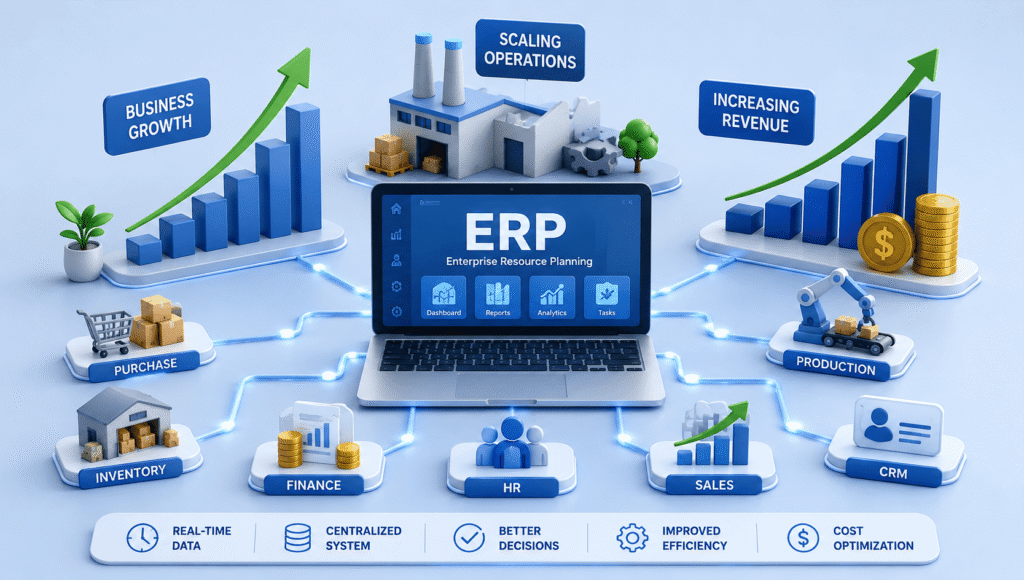
ERP software helps organizations maintain better control over daily operations, improve workflow management, and ensure accurate information sharing across departments. These capabilities help businesses operate more efficiently while supporting scalability and future expansion. Another important advantage of ERP software is improved decision-making through real-time business data and reporting.
Companies can monitor financial performance, inventory movement, employee productivity, and customer activities more accurately, allowing management teams to plan resources effectively and respond quickly to operational challenges. Businesses exploring ERP system benefits for business often find that ERP software improves productivity, reduces manual administrative tasks, and strengthens long-term operational stability. This explains why businesses need ERP software to maintain consistent growth and improve overall business efficiency.
ERP System Benefits for Business
There are several ERP system benefits for business operations, especially for organizations managing growing workloads and multiple departments.
Improved Operational Efficiency
One of the biggest advantages of ERP software is operational efficiency. Businesses can automate repetitive tasks and reduce manual data entry. This allows employees to focus more on strategic activities instead of administrative processes.
Centralized Business Data
ERP systems store information in a single database, making it easier for departments to access accurate and updated records. This reduces data duplication and improves collaboration between teams.
Better Decision-Making
ERP reporting tools provide management with real-time business insights. Decision-makers can monitor financial performance, inventory levels, and operational trends more accurately. Access to reliable data supports faster and more informed business decisions.
Enhanced Customer Service
ERP software helps businesses process orders faster, manage customer records efficiently, and improve communication between departments. Accurate order tracking and inventory visibility contribute to better customer satisfaction.
Reduced Operational Errors
Manual processes often lead to calculation mistakes, duplicate entries, and communication gaps. ERP systems automate many workflows, helping businesses reduce errors and improve consistency.
Scalability for Business Growth
As businesses expand, managing operations manually becomes more difficult. ERP systems support growth by handling increasing workloads, additional users, and expanding operational requirements.
How ERP Improves Business Efficiency?
Many organizations invest in ERP solutions because they want to understand how ERP improves business efficiency in practical terms. ERP systems improve efficiency by creating structured workflows and reducing dependency on disconnected processes.
Process Automation
ERP software automates tasks such as:
- Invoice generation
- Purchase approvals
- Payroll processing
- Inventory updates
- Financial calculations
Automation reduces processing time and improves operational accuracy.
Faster Communication Between Departments
Departments often rely on shared information. ERP systems allow teams to access the same data in real time, reducing communication delays and improving coordination. For example, the sales department can instantly check inventory availability before confirming an order.
Reduced Manual Reporting
ERP software generates reports automatically, helping businesses save time on spreadsheet preparation and manual calculations. Managers can review dashboards and operational reports whenever needed.
Better Resource Planning
ERP systems help companies allocate resources more effectively by analyzing workload, inventory levels, procurement schedules, and operational capacity. This improves productivity and supports better planning across departments.
Why Businesses Need ERP Software?
Understanding why businesses need ERP software becomes easier when organizations experience operational challenges, such as:
- Disconnected systems
- Inconsistent data
- Delayed reporting
- Inventory inaccuracies
- Communication gaps
- Manual administrative workload
ERP software addresses these issues by providing an integrated platform for managing business operations. Small businesses, mid-sized companies, and large enterprises can all benefit from ERP implementation, depending on operational complexity and business goals.
Industries commonly using ERP software include:
- Manufacturing
- Retail
- Distribution
- Healthcare
- Construction
- Logistics
- Professional services
- E-commerce
ERP systems help these industries maintain operational control while improving visibility and process management.
How to Choose the Right ERP System?
Selecting the right ERP system requires businesses to evaluate their operational requirements carefully.
Important factors include:
- Business size
- Industry requirements
- Budget
- Scalability
- User experience
- Customization options
- Integration capabilities
- Vendor support
Cloud-based ERP systems have become increasingly popular because they provide remote accessibility, lower infrastructure costs, and easier software updates. Businesses should also consider implementation planning, employee training, and long-term support before selecting an ERP solution.
ERP Software as a Foundation for Smarter Business Operations
Understanding what an ERP system actually does helps businesses estimate how integrated software can improve operational control, reporting accuracy, and workflow management. ERP systems support finance, inventory, sales, procurement, human resources, and customer management through a centralized platform that improves coordination across departments.
Businesses using ERP software can reduce manual processes, improve data visibility, strengthen reporting capabilities, and maintain more organized operations. As companies continue to expand, ERP systems provide the structure required to manage increasing operational complexity while supporting long-term business objectives.
Looking to improve operational efficiency and manage your business through a centralized system?
Explore ERP solutions with Taxonify and discover how the right ERP software can support long-term business growth and performance.